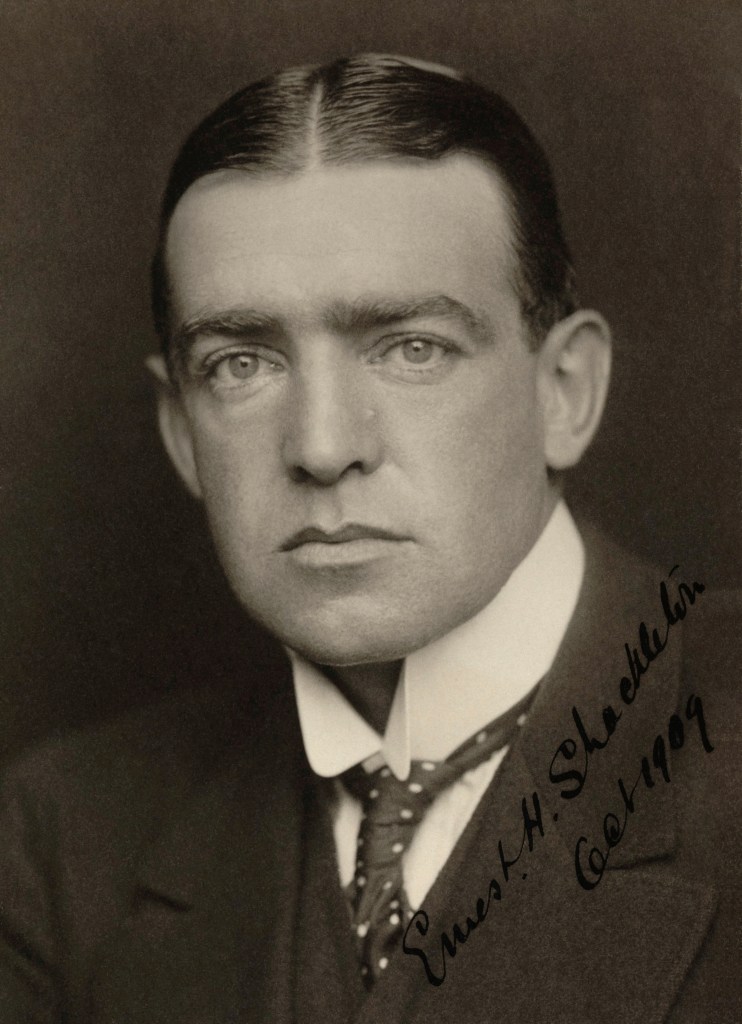
Ernest Shackleton did not talk like a poster about leadership. He talked like an Irish-born explorer who had already been close to death on the ice: soft-voiced, purposeful, a little wry, and always circling back to the men and the next mile. This Founder Voice Card collects how he actually sounded, in short lines recorded in Alfred Lansing’s Endurance, the book behind Deeply Driven’s Shackleton series.
How he talked
Word choice. He sounded like a ship’s commander, not a speechwriter. He leaned on plain words: boys, duty, home, fortune, Please God, I pray God. In the diary he kept the sentences short. In the tents and boats he gave orders without ornament: Launch a boat! Let’s go down. When he needed a picture, it was homely. After the first bad pressure from the ice, he told the men about a mouse in a tavern who drank his fill, twirled his whiskers, and asked where the cat was.
Rhythm. He spoke softly and somewhat slowly, Lansing writes, in an indefinite baritone, with just the recollection of a brogue from County Kildare. A thought often starts quiet and lands on a short line. In the diary those landings are almost bare: Curious Christmas. Thoughts of home. We’ve done it. Keep those landings when you quote him. The understatement is part of the voice.
Humor. He used it to steady the men, not to perform. The mouse story is a joke with a point. At the end of the journey his humor is drier still. Standing in rags at the Stromness station door, he gave his name as if it were an ordinary introduction.
Cursing. In Lansing he stays pretty clean. The salt that does appear is mild, and often it belongs to the parable or to someone else. The mouse in the tavern asks, “Where’s that damned cat?” The station manager, not Shackleton, is the one who says, “Who the hell are you?” Do not turn him into a ranter, and do not scrub out the occasional damned when the line is his.
In his own words
Fourteen of Shackleton’s own lines, in expedition order.
Quotes are drawn from Alfred Lansing’s Endurance: Shackleton’s Incredible Voyage (1959), which records Shackleton’s diary, letters, and what the men heard him say.
“You’re engaged. Join your ship until I wire for you. I’ll let you know all the details as soon as possible. Good morning.”
Alfred Lansing, Endurance: Shackleton’s Incredible Voyage (1959), Part One, chapter 2. What he told Frank Worsley after a brief conversation in the expedition office on New Burlington Street, London. With that, Worsley was appointed captain of the ship.
“Now then, where’s that damned cat?”
Endurance, Part One, chapter 6. The punch line of a story he told the men in the Ritz, the ship’s common room, after the pack’s first heavy attack. A mouse in a tavern drinks his fill of beer, twirls his whiskers, and looks around arrogantly. The parable was meant to check their new confidence that the ship could take any pressure.
“I pray God I can manage to get the whole party safe to civilisation.”
Endurance, Part Two, chapter 1. Written on the eve of the first march across the ice, after the ship had to be abandoned. Lansing uses the British spelling civilisation.
“Curious Christmas. Thoughts of home.”
Endurance, Part Two. His whole diary entry for Christmas Day, 1915, during the second attempt to sledge west with the boats. Another man in the party wrote a longer reflection; Shackleton recorded only this.
“The last day of the old year. May the new one bring us good fortune, a safe deliverance from this anxious time and all good things to those we love so far away.”
Endurance, end of Part Two. Written on December 31, 1915, after the second march had failed.
“I’m rather tired. I suppose it is the strain.”
Endurance, Part Three. Written at Patience Camp, after the expedition, the loss of the ship, and two attempted marches had all failed, with twenty-seven other lives in his hands. Later the same stretch he added, “I long for some rest, free from thought.”
“This may be the turn in our fortune.”
Endurance, Part Three. Written, Lansing says, almost timorously, after a southwest breeze finally held and the temperature began to fall (the drift they needed).
“Please God we will soon get ashore.”
Endurance, Part Three. Written the night they sighted land again, nearly sixteen months after they had last seen black rock.
“Launch a boat!”
Endurance, late in the first half of the book. Called out of the darkness after the floe split under the tents and Shackleton was carried away on a shrinking piece of ice. The men rowed toward his voice and brought him back.
“In the event of my not surviving the boat journey to South Georgia, you will do your best for the rescue of the party. You are in full command from the time the boat leaves this island, and all hands are under your orders.”
Endurance, Part Five. From the letter he wrote in his log on April 23, 1916, at Elephant Island, and left with Frank Wild. He closed, “I have every confidence in you, and always have had. May God prosper your work and your life. You can convey my love to my people, and say I tried my best.”
“We shall be on Elephant Island to-morrow. No one has ever landed there before, and you’ll be the first ashore!”
Endurance, during the boat journey to Elephant Island. Called in the darkness to Perce Blackborow, the young stowaway, whose frostbitten feet were already in grave danger.
“We’ve done it.”
Endurance, Part Six, chapter 6. Spoken when South Georgia first appeared through the clouds, about ten miles away. Lansing writes that his voice was strangely unsteady, and that no one else said a word.
“Let’s go down.”
Endurance, Part Seven. Spoken quietly when he, Worsley, and Tom Crean, after thirty-six hours crossing the island, looked down on the men and sheds at the Stromness whaling station.
“My name is Shackleton.”
Endurance, Part Seven. His answer, in a quiet voice, when the station manager, Thoralf Sørlle, opened the door, stared at the three ragged men, and asked who they were.
Hear the story
These lines come to life in Deeply Driven’s three-part Shackleton series, Heart of Endurance. All three parts are out:
The full series page is deeplydrivenpodcast.com/ernest-shackleton-2.